Big Cypress Fox Squirrel
Sciurus niger avicennia
Scientific name
- The genus name Sciurus is from the Greek words skia (shadow) and oura (tail), a reference to the bushy tail which casts a shadow on the squirrel. The Latin species name niger (black) refers to the black color phase which is common in this species.
Common name
- Fox squirrels may have earned their name from their gray and red fur coat that resemble that of a gray fox, from their comparatively large size and thick bushy tail, and/or from peculiar way of running along the ground which gives the appearance of a small fox.
Lifespan
- Fox squirrels live from four to seven years of age on average in natural conditions. One individual lived to 18 years of age in captivity.
Home range
- Ranges vary from 8-32 acres depending on habitat conditions. Fox squirrels have large overlapping home ranges and are non-territorial.
Geographic Range
- Fox squirrels are found throughout most of Florida except
in the Keys. There are three subspecies of fox squirrels in Florida. The
Big Cypress Fox Squirrel, Sciurus niger avicennia, is
found from the Caloosahatchee River in Lee county south and then east to
the southern part of Dade county. Sherman's Fox Squirrel, Sciurus
niger shermani is found throughout most of the peninsula. The Carolina
Fox Squirrel is found in the panhandle and northwards.
- Contrary to two common names sometimes given to the Big Cypress Fox Squirrel -- Mangrove Fox Squirrel and Everglades Fox Squirrel -- it is not common in either mangrove or Everglades habitats. It is most common in open pinelands, live oak forests, and stands of bigger bald cypress.
- Fox squirrels are found throughout the eastern and central United States, south into northern Mexico, and north into Canada. They have been introduced into urban areas in western North America as well.
Status
- Big Cypress Fox Squirrel:
threatened species
- Sherman's Fox Squirrel: species of special concern
Habitat
- Fox squirrels spend more time on the ground than gray
squirrels and are slower moving. They forage for acorns, nuts, fruits,
insects, mushrooms, buds and tubers, so they require habitats with an open
understory. These include open pine flatwoods, sandhills, mixed pine-hardwood
areas and rangeland interspersed with trees. In Florida, the fox squirrel
may also be found in cypress stands and occasionally mangrove swamps.
- Further north, fox squirrels are found in a diverse array of deciduous and mixed forest. Areas with a good variety of tree species are preferred due to variability in mast production.
Physical Characteristics
- Fox squirrels weigh from one to three pounds, and exhibit
color variations which range from a buff color to gray, and in some instances
black. The under parts are usually lighter, and typical specimens
have white noses with black faces and feet. They are noted for their
long, bushy tails and for their strong hind legs which allows them to leap
easily from place to place.
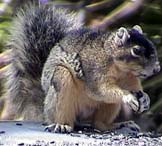 Fox
squirrels have both a summer and winter coat, and therefore molt twice
each year. The spring molt begins in March and may last for weeks, left,
whereas the autumn molt begins in September. But the tail only molts
once each year during the summer.
Fox
squirrels have both a summer and winter coat, and therefore molt twice
each year. The spring molt begins in March and may last for weeks, left,
whereas the autumn molt begins in September. But the tail only molts
once each year during the summer.
- Fox squirrels have four sets of whiskers located above and below the eyes, on the underside of the head in front of the throat, and on the nose. Whiskers, also known as vibrissae, are touch receptors that provide the animal with information about its immediate surroundings.
- Fox squirrels have very good eyesight even in dim light, and a wide field of vision. They also have a well developed sense of smell and hearing.
- The skull of the fox squirrel has 20 teeth (gray squirrels have 22 teeth). Squirrels have upper and lower incisor teeth followed by a gap called a diastema. The diastema is where the canine teeth would normally be found in carnivorous animals such as cats or dogs, or omnivorous animals such as monkeys. Behind the diastema are the cheek or grinding teeth which consist of premolars and molars.
- As with other rodent species, the incisors continuously grow to compensate for the enormous amount of wear that comes from a herbivorous diet.
- Young squirrels have milk teeth which are replaced by permanent teeth when they are between six and twelve months old.
- Fox squirrels are highly adapted for climbing trees and fatal falls are rare. Adaptations for climbing include sharp recurved claws, well developed extensors of digits and flexors of forearms, and abdominal musculature.
- Tails are used for balance when running and leaping between trees, and held over the back of a resting animal.
Reproduction
- Fox squirrels can mate any time of year, but they typically
have two breeding seasons. Males collect in the home range of a female
when she begins estrus. Dominance hierarchies form among the males to determine
mating privilege. Mating chases involve one female and a number of males,
with the successful male guarding the female to prevent others from mating
with her; males do not help in the raising of young. Copulation lasts less
than thirty seconds, and females can mate with several males. A copulatory
plug forms after mating.
- Females can produce two litters in a year, although one is the norm. The winter litter is generally smaller than the summer litter.
- Functional testes descend in the scrotum from December to February and May to July, although testes may stay descended without spermatogenesis until October.
- Both sexes remain reproductively active throughout their lives.
- Sexual maturity : 10 to 11 months for males, 8 months for females
- Mating season: Fox squirrels usually have 2 breeding seasons and litters a year. Breeding season peaks in January-February and again in May-June.
- Gestation: 42-49 days The young are weaned in 2 months and on their own in 3 months.
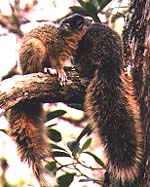 Number
of young: 3 to 4 young are born naked, blind, helpless, and weigh between
13-18g. Eyes open at week 5. They remain in the nest 7 to 8 weeks.
Number
of young: 3 to 4 young are born naked, blind, helpless, and weigh between
13-18g. Eyes open at week 5. They remain in the nest 7 to 8 weeks.
- Dispersal of young: Juvenile males are more likely to leave the natal area and disperse than are juvenile females. Dispersal usually occurs during the fall and young males move between 1 and 16 kilometers away from their natal nest. The longest recorded dispersal is 100 km. Dispersal is a high cause of mortality among males, which results in a slightly female biased sex ratio.
Nests
- Fox squirrels nest in cypress, cabbage palms, and pines.
- Fox squirrels typically use 3 different types of nests: winter dreys, summer dreys, and dens.
- Dreys are round conspicuous twig and leaf nests built in trees between 25 and 45 cm in diameter. They are waterproof, and made of an outer layer of interwoven twigs with a softer inner lining consisting of moss, bark, leaves, fur, feathers, lichen or other similar material.
- Summer dreys are less elaborate than winter dreys and may be no more than twig and leaf saucer shaped platforms on exposed branches. Dreys are generally built in the upper 1/3 of the canopy and seldom in isolated trees, which may serve to protect nests from predators.
- Tree dens are another type of nest used by fox squirrels. These are holes or cavities in the main trunks of trees which are also lined with soft material. Squirrels often use dens in winter months and dreys in summer months.
Behavior
- Generally, fox squirrels are not gregarious, although
they come together during the breeding season when females are in estrus.
Males have larger home ranges than females.
- Squirrels threaten one another by an upright stance with their tail over their back, followed by a quick flick of the tail.
- Scent-marking is another form of intra-specific communication used by fox squirrels.
- Vocalizations in the form of barks and chatters, distress screams, and high-pitched whines during mating are common. Fox squirrels are serially polygynous.
- Fox squirrels are active year round during the daytime. Activity is bimodal from late spring to autumn with peaks two hours after sunrise and again from two to five hours before sunset.
- Squirrels mark their feeding territories with scents from glands on the sides of their mouth that they rub against trees.
Food Habits
- Fox squirrels are generalist feeders and their diet is
dependent upon the area in which they are found.
- They forage on the ground and in trees, eating slash pine and cypress seeds, cabbage palm fruit, acorns, and figs.
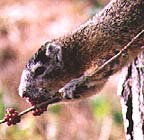 They will
also eat the inner bark of trees as well as flowers, buds of some oak species,
the fruits, seeds, buds or flowers from a variety of trees including maples.
Pine tree seeds and pollen cones are readily eaten. Fungi are also consumed
when readily available in summer, as are cultivated crops in winter.
They will
also eat the inner bark of trees as well as flowers, buds of some oak species,
the fruits, seeds, buds or flowers from a variety of trees including maples.
Pine tree seeds and pollen cones are readily eaten. Fungi are also consumed
when readily available in summer, as are cultivated crops in winter.
- Animal food items include bones, bird eggs, nestlings, gall insects, moths, beetles, bird, eggs, frogs, and even dead fish.
- Fox squirrels are classic scatterhoarders (they cache seeds in a scattered fashion). They carry nuts and seeds in their jaws and bury them in various locations within their home ranges. Olfaction and memory are used in locating their caches, but they only find a portion of the nuts they bury and are important in planting many species of trees and shrubs that produce nuts and seeds.
- Nuts are opened by a levering technique of the lowering incisors, a skill at which squirrels become proficient quickly.
- Food consumption peaks in summer or autumn and decreases in winter. Autumn rates of food consumption exceed energetic needs by 32% so that the animals can increase their weight before the onset of winter.
Predation
- Owls, hawks, foxes, the coyote, and the bobcat are major
predators of the Fox Squirrel.
- When threatened or alarmed, the Fox Squirrel makes a barking call or chatter while rapidly waving its tail from side to side. The Gray Squirrel shows similar behavior, but its call is of higher pitch.
Afflictions
- Mange is the most common affliction affecting squirrels. More information is below.


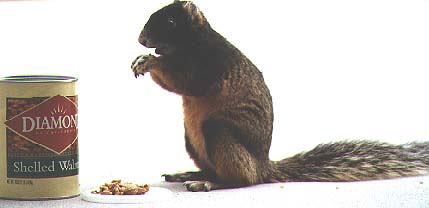
 Mange
Mange Clinical Signs